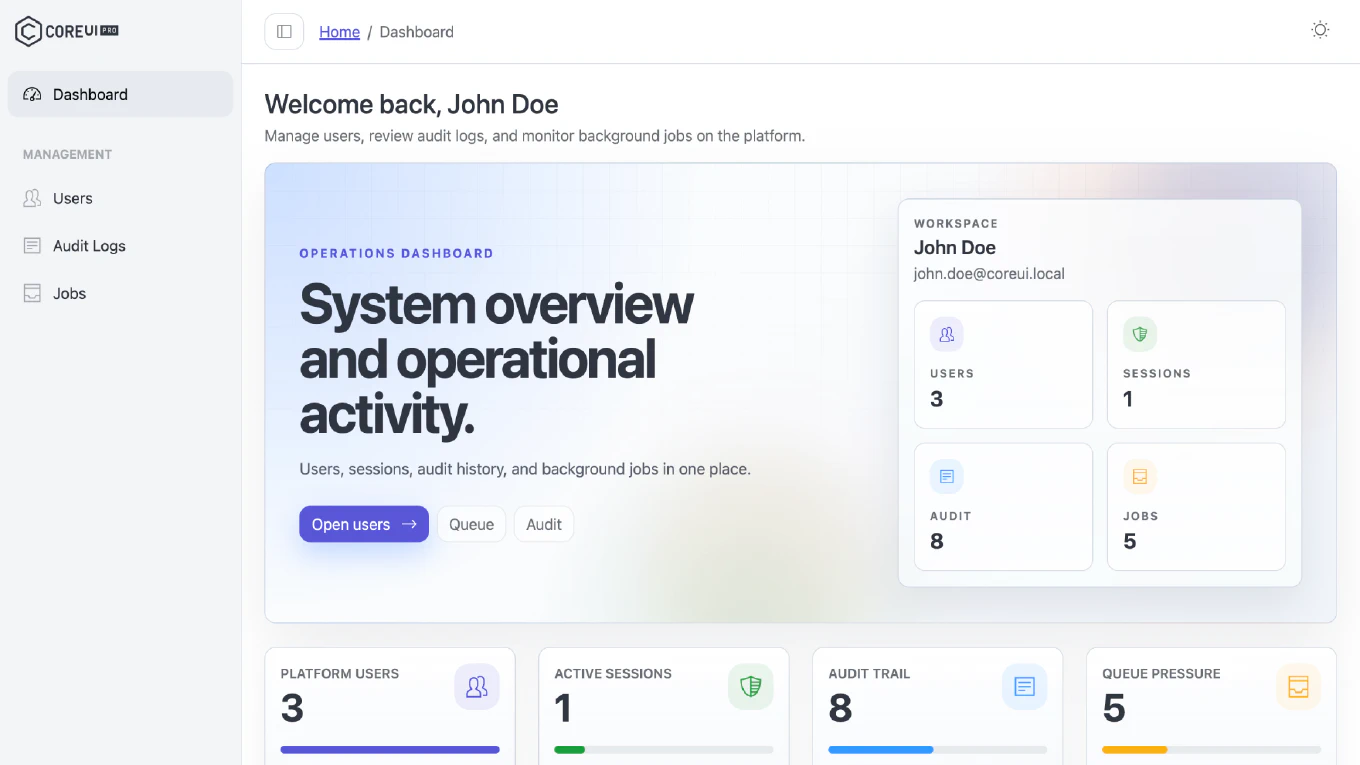
How to integrate CoreUI with React for enterprise apps
Building enterprise-level applications requires a robust architecture, consistent UI, and scalable components that can handle complex data flows. As the creator of CoreUI, I have designed our React library specifically to meet these professional requirements. Since 2014, I have focused on refining React and Node.js ecosystems to ensure they meet the rigorous standards of corporate environments. Integrating CoreUI with React provides a battle-tested foundation that simplifies state management and UI consistency across large teams.
How to use CoreUI Pro with React
Setting up a high-performance enterprise dashboard requires advanced components like Smart Tables and Multi-Selects that go beyond basic UI kits. As the creator of CoreUI, I’ve designed the Pro version to eliminate the overhead of building complex data-heavy interfaces from scratch. The most efficient and modern solution to use CoreUI Pro with React is to install the @coreui/react-pro package and integrate its enterprise-ready components into your project structure. This approach ensures you receive the latest updates and premium support directly through your standard development workflow.
How to consume private npm packages in React
Managing dependencies in a professional React environment often requires access to proprietary code stored in private registries.
As the creator of CoreUI, I have architected numerous internal design systems that rely on private npm packages for secure distribution.
The most efficient and modern solution for consuming these packages is to configure a project-level .npmrc file that utilizes environment variables for authentication tokens.
This approach ensures that your credentials remain secure while allowing your React application to build seamlessly across local environments and CI/CD pipelines.
How to document components in React
Documenting React components is a critical task that ensures your codebase remains maintainable, scalable, and accessible to other developers. As the creator of CoreUI, I’ve built and documented hundreds of complex components for millions of users worldwide. From my expertise, the most efficient approach is a multi-layered strategy combining JSDoc for inline descriptions, TypeScript for structural type safety, and Storybook for visual documentation. This combination provides immediate feedback in modern IDEs and creates a live style guide for your entire design system.
How to publish a React component to npm
Publishing a React component to npm is the gold standard for sharing reusable UI logic across projects or with the developer community. As the creator of CoreUI, I’ve built and published hundreds of packages that power thousands of applications worldwide. The most efficient and modern approach involves bundling your component using a tool like Rollup to support both ESM and CommonJS formats while managing dependencies correctly. This ensures your library is lightweight, tree-shakeable, and compatible with various build environments like Vite, Next.js, or Webpack.
How to use Storybook in React
Building complex user interfaces requires a strategy that prioritizes isolation and predictability.
As the creator of CoreUI, I’ve built thousands of components that rely on robust documentation and visual testing.
The most efficient and modern solution for managing component lifecycles in React is to implement Storybook, which enables Component-Driven Development (CDD).
By using Storybook, you can develop components without worrying about application-specific logic, APIs, or data structures.
How to version React components
Managing breaking changes in shared React components is one of the most significant challenges in large-scale frontend architecture.
As the creator of CoreUI, I have overseen the evolution of component libraries used by millions of developers, where versioning is the backbone of stability.
The most efficient and modern solution is to implement Semantic Versioning (SemVer) distributed via a package manager or managed through a monorepo with automated tools like Changesets.
This approach ensures that downstream applications can upgrade with confidence while maintaining a clear history of API modifications.
CoreUI for React v5.11.0 - Maintenance Update

We are pleased to announce the release of CoreUI for React v5.11.0. This release rolls up maintenance improvements and keeps CoreUI for React projects current. No breaking changes were announced in the published release notes.
CoreUI PRO for React v5.25.0 - Maintenance Update
We are pleased to announce the release of CoreUI PRO for React v5.25.0. This release rolls up maintenance improvements and keeps CoreUI PRO for React projects current. No breaking changes were announced in the published release notes.
How to build a design system in React
Building a design system in React is about more than just a component library; it is about creating a single source of truth for your UI logic and visual identity. As the creator of CoreUI, I’ve architected dozens of design systems that power enterprise-level applications. The most efficient approach involves using design tokens for constants, the React Context API for theming, and a component-driven architecture to ensure modularity. By following these principles, you can create a robust system that improves both developer velocity and design consistency across your organization.